


I’ve lived in the same San Francisco zip code for almost thirty years.
Last month the house next door sold. It was a pocket listing – never hit the market, gone in three days. Thirty-five percent over asking, all cash, no inspections. I knew in abstract that AI money was sloshing around the city, but watching it happen forty feet from my kitchen made it real.
A few days ago I came home and found, forty yards up the street in the other direction, chalked across a retaining wall in a kid’s handwriting:
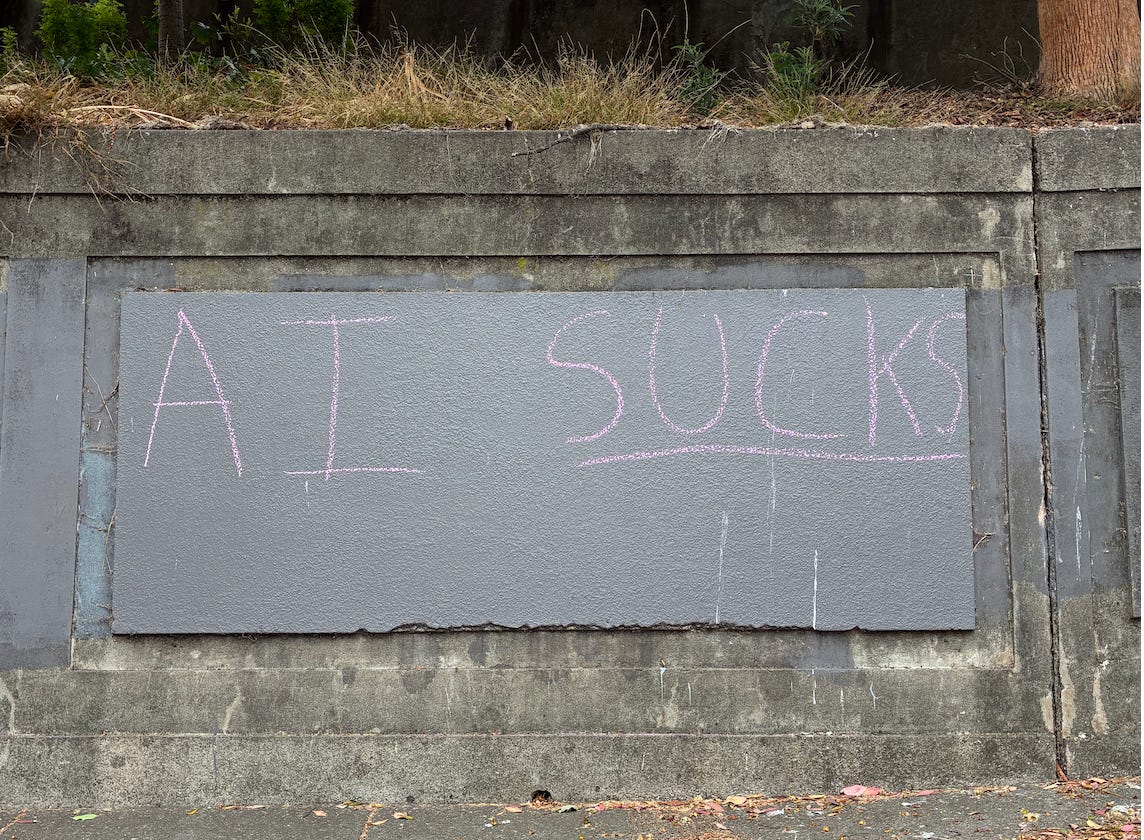
Some neighborhood kid with a piece of sidewalk chalk and a grievance. What makes it ironic is that the couple who bought the house next door work at the two AI labs you’d name first if I asked you to name two.
But the kid isn’t wrong, and he isn’t alone.
Don’t worry, it’ll all work out. The subtext is, don’t be a Luddite.
The bill is going to people who never made the bet
Go to Mount Pleasant, Wisconsin. In 2017, Foxconn promised a $10 billion LCD plant and thirteen thousand jobs. Trump held a golden shovel at the groundbreaking. The plant never really happened. The state changed the deal. The land sat unused.

Today that land is a Microsoft data center, Fairwater, home to what Microsoft calls the world’s most powerful supercomputer. There was real investment in the project, resulting in real construction jobs, roughly $4.7 billion through 2028.
Today, there are 375, targeting 800. Thirteen thousand were promised.
The most powerful computer ever built by man is sitting on top of a jobs promise nobody kept. The honest, hard-working people of Racine County are supposed to read that as a win.
Then there’s the meter. Average U.S. residential electric bills are up 29% since 2020. In Virginia’s Data Center Alley and everything around it, residential and commercial customers paid $4.4 billion in data-center-related transmission costs in a single year. Thirty-plus states have introduced hundreds of bills trying to determine who should pay the grid costs AI now requires.
My electricity bill could double tomorrow and I wouldn’t notice. But thirty years ago I lived month to month, and a thirty-dollar jump in a utility bill would have presented a serious problem. It would’ve changed whether I bought a sandwich at Tressider Café as a graduate student or brought cold spaghetti in a plastic container for lunch for a month.
So let’s use our empathy and run the trade from a regular American’s kitchen table. You’re being asked to help finance the power infrastructure for a technology whose most-advertised feature is that it will replace your job. And when you ask the obvious question – hey dude, what’s in it for me? – the answer you get from the smartest people in my industry is: Don’t worry, it’ll all work out. The subtext is, don’t be a Luddite.
That’s not an answer. That’s a dick-headed demand for acquiescence with nothing back.
The numbers don’t foot
In this Substack I previously argued that every bubble leaves a gift. Railroads left the freight network. Global Crossing and Worldcom and Nortel strung more fiber than the world could use, went to zero, wiped out their shareholders and their employees – and left behind the pipes that Netflix and Amazon were built on.
The bubble burst. The gift remained.
I still believe that, but I gave short shrift to the other half of the story. I need to set things straight.
Global Crossing’s shareholders paid for that fiber. It was their money, their bet, their loss. That’s how capitalism is supposed to work: the people who chase the upside eat the downside.
This time the check is amortized across millions of taxpayers who are having the bill shoved down their throats. AI capex drove something like 74% of U.S. GDP growth in the first quarter of this year. The economy isn’t growing because of what AI produces. It’s growing because of what we’re spending to build it. That’s a supply-side boom priced on demand that is yet to materialize, and the ratepayer in Racine is a co-signer on the loan without ever having been asked to weigh in, much less vote, on the matter.
Half of American adults now say AI makes them more concerned than excited. In 2021 the concerned number was 37%. The trend is going in the wrong direction, and the AI accelerationists should take note.
Why this is going to hurt
Here’s the part my side of the aisle needs to sit with.
Trump and his followers are the only people who bothered to answer the American voter’s question, what’s in it for me. “America First” landed because progressives got enthralled by abstract global principles and forgot there’s a guy in Des Moines who just wants to know how any of those abstractions make his life better. My side got precious and focused on the wrong thing. The other team answered. Badly, cynically, dishonestly, but it worked, because a bad answer delivered in an easy-to-remember-and-recite slogan (“Make America Great Again,” “Build a Wall,” “Lock her up”) beats pearl-clutching and an 80-page policy paper every time.
Now Andreessen and the accelerationists run a similar play. AI safety people are “Baptists and Bootleggers,” and “Deaths that were preventable by the AI that was prevented from existing is a form of murder.” Any discourse that questions AI is “full-blown moral panic.”
Sit down. Shut up. Stop being a Luddite. It’ll all work out.
It’s the same type of contempt that globalist Dems decrying ‘deplorables’ showed to anyone who disagreed with them, only now under a different banner. It’s bound to produce the same result.
Except this time the backlash lands on us.
What an actual answer could start to look like
I don’t claim to have solved this, but here are some non-negotiables to start.
Pay your own power bill. If your data center needs a substation, your data center funds the substation. Large-load tariffs, ratepayer firewalls, whatever the mechanism. American taxpayers shouldn’t pay the AI data center bill any more than they should have paid the bailout bill of the bankers who wrecked the economy with collateralized debt obligations during the Great Recession. Your capex is a personal problem; don’t put it on us. (And come up with something more thought-out than, “If we don’t do it, Xi and the CCP will win.”)
Say the jobs number out loud before the ribbon cutting. Not construction jobs. Permanent jobs. Publish it and hold people to it. “375, targeting 800” is better than zero. It’s only insulting when it arrives after promising thirteen thousand.
Ship something a normal person can name and understand. Not a meme, not a slogan, not a demo. If the only people who can articulate the benefit are the people getting paid, you don’t have a product, you have a thesis. A one-sided thesis, at that.
Stop calling anyone who questions you a Luddite. “What’s in it for me” is not a failure of imagination. It’s the founding question of every legitimate bargain in a market economy or a rules-based democracy. When you refuse to answer it, you’re not defending progress, you’re admitting you don’t have a plan.
While I’ve lived in San Francisco, I’ve seen three bubbles and two busts – so far. We’re in a bubble, and bubbles always pop. The gift will still be there underneath the wreckage.
But the promise of a future gift isn’t an argument or an answer. Someone needs to answer the kid’s question today. If it’s not those of us in the business of AI, it looks like it’ll be a politician with a golden shovel and a promise he has no intention of keeping.
We gotta do better than that.
Enjoyed this perspective as usual, Tom! :) Thanks for sharing.