


“To know what we think, to be masters of our own meaning, will make a solid foundation for great and weighty thought.” – Charles Peirce
The aesthetics of a pitch deck change over time, and the winners get copied to death. In the ‘80s it wasn’t even a deck — it was an acetate transparency on an overhead projector. By the ‘90s you couldn’t spit in Silicon Valley without hitting clip art and a lens flare; then came the glossy black slide with one giant word on it, then the Sequoia-template deck with its “Uber for X” declaration. And on and on it went.
I’m used to the trends changing, and I like to think that after nearly thirty years in this business I can still change right along with them. So when a deck showed up in my inbox a few months ago – clean, slate-gray, lots of white space, a tidy row of little icons – I honestly found it refreshing. Then, within days, it was nearly the only thing landing in my inbox. It didn’t take long to find the culprit: this was Claude’s default aesthetic.
The problem was not isolated to visuals. They weren’t even the worst offender. It was the verbiage in the emails. The 6-page memos which sounded polished without seeming to say anything at all. You know what I’m talking about. You’ve received it. The slop that arrives in your inbox with a real human name on top.
I tried to come up with a word for this type of vending-machine output of the LLMs. But what’s notable here isn’t so much the output – the output is interchangeable and forgettable. What’s notable is the way it makes you feel to receive it. You get a note from a human, it’s almost human, but you know it isn’t. You know it’s the machine cosplaying whoever your email came from.
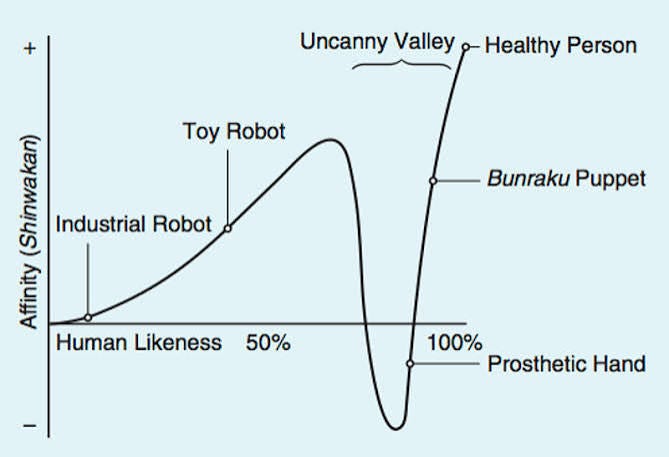
The grating, uncomfortable feeling that summons in the human brain already has a name, just from a slightly different domain. We can thank roboticist Masahiro Mori for it. He called it the uncanny valley.
A recent interaction with a junior employee turns the uncanny even... uncannier. I was jamming up this very smart, very capable kid for filling my inbox with a 9-page nothing-burger of a memo. “Okay, but that wasn’t me,” he said. “That was Claude.” Thankfully for all of us, I self-regulated. Because my anger isn’t really with this kid. It’s that we’re taking this wondrous technology and using it with the same level of regard as a vending machine. Jam your prompt in, wait for the output to fall down like a Snickers bar. Call it a day.
It’s really easy to blame the 23-year-old kid for this problem. But he didn’t create it. Bosses like you and I did. We rewarded polish. We rewarded volume. There was always folly in that, but it was much more justified ahead of AI. Polish was an easy proxy for effort. Volume was too.
Back in the 1970s, IBM measured programmer productivity by the thousands of lines of code they shipped. Bill Gates famously punctured this practice by saying that “measuring programming progress by lines of code is like measuring aircraft building progress by weight.” But we didn’t learn the lesson, and in various forms we’ve been paying people to build the world’s heaviest airplanes ever since. Now, in the age of AI, output and polish are free. So if you’re the one signing the checks, it’s time to change the incentive structure. I have no easy solutions, but here’s where I’m starting:
Never ship the snickers. It is not a vending machine. it’s a sparring partner. it’s a research partner, it’s a diligence tester. Argue with it, reject its work, edit vigorously. It’s slower and better and way more fun.
Reward the thinking, not the volume. Length and polish don’t move me the way they used to, because they cost nothing now. Three tight sentences that say something real beat nine immaculate pages. My strongest employees are the ones who know what they think and can say it plainly.
Institute BLUF: bottom line up front. Make your point, your argument, your recommendation right at the top, and own it. The reasoning for landing there comes after. If you can’t put the thing in the first line, odds are you haven’t figured out what the thing is yet.
Own what you send and send it in your own voice. The machine will hand you the polish every time. Whether there’s any judgment underneath it, or your own voice sending it, is still entirely on you.
Enroll your employees. I just emailed my team this morning. The slop stops here. Here was the post script:
P.S. Full disclosure: I wrote this email by talking into my phone for two minutes, transcribing, and asking Claude to draft it with my “email-as-Tom” skill. But look at who did what. It began with my own perspective, in my own words. It ended with my own judgment. The machine did the drafting and the polish, which is the part that’s now free... and now table stakes.
If you want my Claude Skill that trains off your voice to give you a better first draft, shoot me a message.
https://vibecoding-motherfucker.com/
"sparring partner" is the right mindset. quickest way to know you're talking to an AI neophyte is that they refer to it like an Easy Button.