


When my son was eight, he and his friends realized their parents were more than people who clothed, fed, taught, and played with them. They also started to realize that fairies didn’t just swoop down from the sky to deliver macaroni and cheese and chicken nuggets for dinner. The concept of a ‘job’ took shape in their little brains, and like boys do at that age, they started asking each other what their daddies did for work.
Jake’s daddy was a fireman, which was super cool. Run into burning houses, save people, shoot water to put out the fire, go back to the station house and recharge before doing it all again.

Sam’s dad was a lawyer. Defend clients, argue with opposing lawyers, and yell “Objection, your Honor!” during court hearings. Epic stuff, just as it was portrayed in television shows.
Julian proudly told his friends that his daddy was a C-E-O. His best friend Malcolm had the good sense to ask, “Hrmmm, what does a CEO do?”
Julian came home that day and, over dinner, asked me the same question. Dammit, I thought. I ought to have a tidy answer – but I didn’t. I knew I had a weird, weird job – but what was it, exactly?
This was the beginning of a 20+ year struggle to define - by doing, not theorizing – what the heck a CEO actually does. In a time when Silicon Valley is overrun with young CEO’s on the move, it feels like a useful question to take up. Lots of people want to be a CEO, but no one really knows what they do.
At the end of his life, the famous management theorist Peter Drucker observed that business schools generated gobs of research on organizational behavior, the behavior of financial markets, strategies for market entrance and competitive positioning, etc. – but it had devoted shockingly little time and research to the question of what a CEO actually does. He took it up late in life but died before he could bring to it the penetrating insight and discipline he had applied to the rest of his work.
Here’s my take. The CEO’s job centers on Four C’s: Conception, Communication, Coordination, and Course Correction.
What’s brutal and possibly unfair about the gig is that you have to cover all four. There’s little partial credit given if you fail to cover any one of the four C’s. And while you should always be seeking to shore up your own deficiencies and white spaces as a CEO, you can’t delegate any one of them to someone else.
The Four C’s of Being a CEO
Conception. This is about having the right idea about why the company needs to exist and what it does – not just today, but tomorrow and the next day, supported by actionable intuitions about how to get from here to there. “And then a miracle happens” isn’t good enough; you have to live in the real world and prescribe slightly unreasonable but still attainable moves the company takes to achieve its overall ambition. You don’t have to have all of the tactics sorted out on your own – this is where your team leans in. But you need to intuit the broad strokes in a deep, practical way.
Conception requires staging and sequencing. If you’re going to have a party, first you make the guacamole. Then you pour the tequila. Then you dance. If you’re executing a heist, as in Ocean’s Thirteen, first you have to get into the vault. Then you need to extract the money from the vault. Then you have to get it out of the building while hundreds of SWAT operators flood the casino floor.
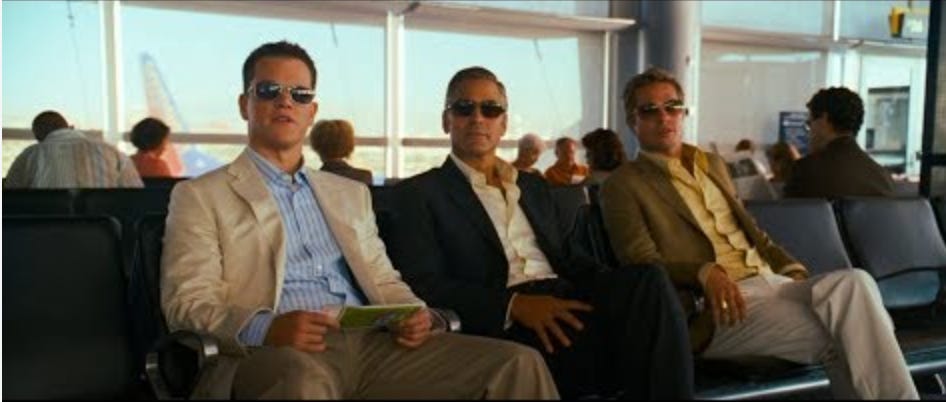
Company conception is like that. Amazon started with books, then expanded into other goods, then externalized the services it built to run its own business into marketplace and cloud services other companies could buy. Netflix started with DVD’s by mail, then streamed movies as a service, then developed its own movies to stream on its own platform.
Communication. Ideas are critical, but if they’re just an abstraction in your own head that no one else understands or buys into, you’re dead in the water. You have to communicate your conception and persuade others to get in the boat and row: employees, investors, partners, and the market watchers trying to make sense of what you do relative to everybody else.
You need a clear plan with a beginning, a middle, and an end. No jazz hands: it’s got to be sensible, coherent, actionable. More than that, it needs to enroll, involve, and inspire others to get the job done.
Coordination. Now you need to oversee the work and deliver the end product. You’re the boss of a factory: There are raw materials (mostly in the form of talent and capital), which get turned into work in progress on the factory floor, which eventually result in finished goods on the outbound dock.
I was a first-time CEO who once believed I needed to throw my body into every breach, my fingers into every hole in every dyke. I eventually learned that my job was to define the work architecture required to achieve my plan: Who does what, by when? How do the roles and accountabilities cohere and hang together to deliver finished goods? What are the choke points and interdependencies? What organizing incentives do I need in place so everyone delivers the outcome I care about at lightspeed?
Course Correction. Arguably the most important of the C’s, course correction recognizes that no plan withstands contact with the enemy. There will be failures, gotchas, and blowups. Your job as CEO is to perceive those failures, diagnose and learn quickly from them, and chart new strategies and tactics that keep you off the rocks and maintain your forward momentum.
Tech people love to talk about pivots. There are hundreds of small ones, and frequently at least one or two big ones, as any company achieves its footing and eventually succeeds.
Again, no partial credit. No superlative, 10-from-the-Russian-judge on one of the four to offset subpar performance on the remaining three. The CEO has to cover them all. Let’s fix ideas with examples.
CEO’s who had some, but not the whole enchilada
Communication without Conception
John Sculley. Marketing genius behind the Pepsi Challenge. Extraordinary communicator. Arrived at Apple with no conceptual grasp of computer engineering or product, famously orchestrated Job’s defenestration. Like General MacArthur, Jobs returned, and the rest is history.
Carly Fiorina. Ran HP when it was a marquee name. Polished on the pitch, but couldn’t read the shifting tectonic plates of her industry at the time. Botched several necessary transitions in hardware and software. Being the silkiest, most persuasive communicator still wasn’t get her all the way there.
Conception without Communication
Early Zuckerberg. Visibly incapable of explaining Facebook to Congress or the press for years. But to his credit, he learned quickly on the job and fixed it.
Coordination without Conception
Steve Ballmer. I saw this one firsthand after Microsoft acquired my first company. Ballmer oversaw elaborate systems to monitor, observe, and measure every nook and cranny of every product, every geography, every customer segment. The entire culture of the company, emanating directly from him, was to prove you had OCD-level command of every inconsequential detail. The what’s-so was everything; the so-what was beside the point. During one QBR I was asked: what was CPM for the auto segment in Brazil in July? And I was expected to know it.
What I thought but didn’t say at the time was, who the fuck cares? The question we should’ve been asking was, why are we pouring so much money to maintain and build an advertising segment that was vanishingly small and declining precipitously month-over-month?
Microsoft under Ballmer in the 00’s was an army of thousands deployed to create extra decimal points in the service of very little. It was a perfect coordination machine bereft of strategy. The stock languished until Satya took the helm and rebuilt the company from the studs up.
Conception without Coordination
Adam Neumann. Thousands of ideas, fancy speeches, no ability to pull it off. According to dozens who tried to work with him, he was a managerial nightmare, unable to give the count, track a workstream, or even remember the objectives he’d loosely set the quarter before.
Conception without Course Correction
John Antioco, Blockbuster. 2000, Netflix approached Blockbuster and offered to sell for $50 million. He laughed them out of the room, but he did eventually course-correct. He killed late fees and launched Blockbuster Online / Total Access, and by Q4 2006 Total Access was adding subscribers faster than Netflix. Carl Icahn ran a proxy fight against him for exactly that spending, and Antioco was pushed out in July 2007. His successor Jim Keyes, a 7-Eleven guy with no digital experience, gutted the online marketing budget, raised online prices, refocused on stores, and reinstated late fees in 2010. The perfect realignment of deck chairs on the Titanic.
While Antioco didn’t see what Netflix was, he tried to course-correct, and the idiots on the Blockbuster board killed him for it. Which underscores a critical aspect of course correction: It isn’t just a CEO skill. It’s a governance imperative. The CEO has to survive the course correction politically, not just call it. He needs to manage his stakeholders through the pivot, and the Board needs to be wise enough to let him do it.
A CEO who wins at all four: Reed Hastings
Conception. Hastings consistently saw where the market was going before it arrived. He built Netflix on a DVD-by-mail subscription with no late fees, which attacked Blockbuster’s most hated feature. He named the company “Netflix” rather than something DVD-specific because he expected streaming years before broadband could support it. He moved into original content with House of Cards in 2013, and launched in 130 new countries at once in 2016.
Communication. He made culture explicit and public. The 2009 “Freedom & Responsibility” culture deck became one of the most-read documents in Silicon Valley. His long-term shareholder memo told investors plainly how Netflix would operate and the hard tradeoffs it would make to build the business. His style was candid and plain-spoken, and established the norm that feedback could and should flow in all directions inside his company.
Coordination. His core managerial principle was “context, not control.” Leaders shared strategy and information widely, then let people make decisions without approval chains. He paired that freedom with talent density: pay top of market, and established the “keeper test” to ask whether a manager would fight to keep someone. His succession plan was the gold standard for succession plans everywhere. He made Ted Sarandos co-CEO in 2020 and handed off to Sarandos and Greg Peters in 2023 without a hiccup.
Course correction. The 2011 Qwikster episode was the defining example of Hastings’ ability to course correct. Netflix raised prices and tried to split DVD and streaming into two brands. Netflix lost about 800,000 subscribers and its stock fell sharply. Within weeks he publicly apologized and killed Qwikster; the company recovered and pushed further into streaming. After subscriber losses in 2022, he again reversed long-held positions by adding an ad-supported tier and cracking down on password sharing. Both moves reignited growth.
To my son all these years later: Thanks for asking the right question. I think I finally arrived at a better-than-half-baked answer.
Like everyone, I keep learning on the job every day. And I’m doing my level best to discover and channel my inner Reed Hastings.