


In 1906, John Philip Sousa, the man who gave us “The Stars and Stripes Forever,” went to war against a machine.
The machine was the phonograph. Sousa was convinced it would kill music. He warned of a contraption that “tells the story day by day, without variation, without soul, barren of the joy, the passion, the ardor that is the inheritance of man alone.”
Swap in “AI.” You’ve recently read that post, right?
Sousa lost. The phonograph put music in every living room in America, built an industry, and brought joy to millions. So why does AI music make our skin crawl?
The fifth limb
Meet “Rubberz.”
Fenix Flexin is an LA rapper, a longtime member of Shoreline Mafia. West Coast. Drawl. This summer he dropped a synth-pop track sung in a plummy British accent straight out of 1985. It went viral, then climbed to No. 58 on the Billboard Hot 100.
Then a producer named Medasin (one of my favorites) showed it had been generated with an AI app called Treblo. Fenix denied it and posted a Pro Tools session as receipts. Medasin showed how easy it is to fake exactly that kind of session from an AI track. Fenix deleted the post. Eventually he copped to it, while insisting he’d never denied it. (He had.)
My problem isn’t that Fenix used AI. It’s that the song doesn’t sound like him. At all. He didn’t use AI to enrich his art or push it somewhere new. He used it to make something that hangs off his catalog like a fifth limb, without the tiniest correspondence to what came before.
Then he has to perform it. A Black rapper who drawls, onstage, trying to make a British new-wave crooner sound like himself. Clips of him apparently lip-syncing it went viral too.
If you’re old enough, you know how this movie ends. Milli Vanilli: Late ‘80s, huge hits, a Grammy for Best New Artist. Then the world found out they hadn’t actually sung a note, and they had to give the Grammy back.
It was awful. Not because a machine was involved. Because everyone lied about how they used the machine.
Why it sucks
We react this way because music is distinctly human. We were beating drums around a fire long before we had language. Music is primal. When it comes out of someone singing, playing a piano, or beating a drum, it tells us something about who they are, and we feel connected to them and to others listening.
One fan, quoted in Elevar Music Magazine, nailed it: “I don’t care if they create the best Tom Petty song ever — it isn’t him and I won’t want it.”
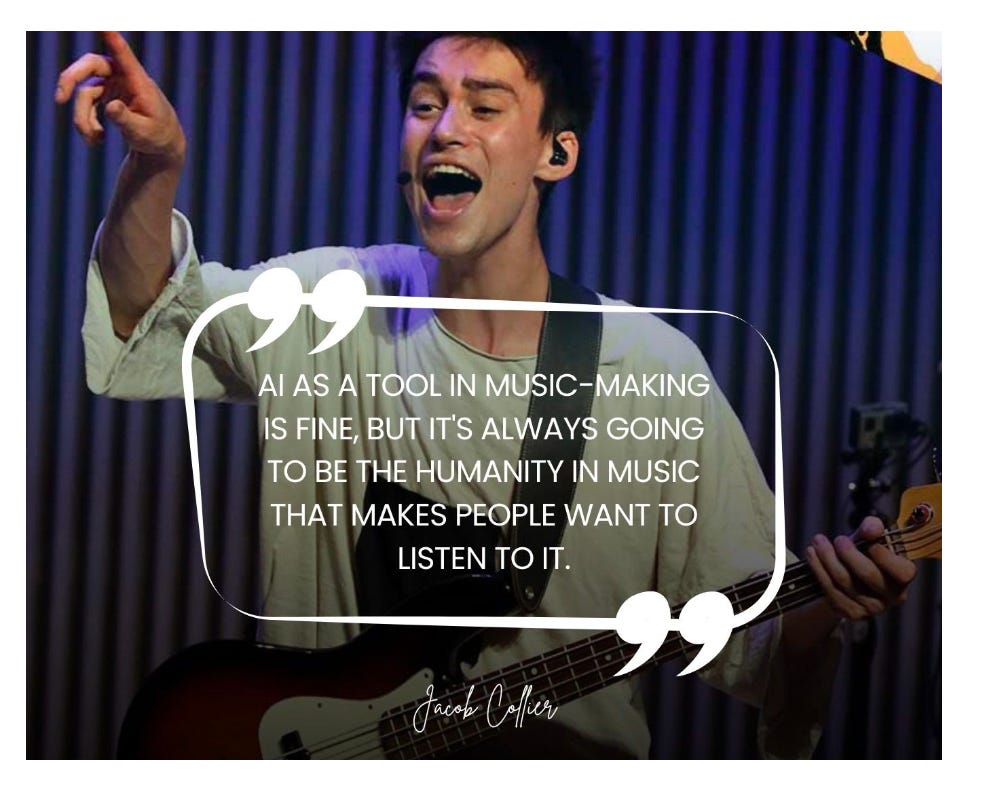
Jacob Collier, maybe the most musical human alive, lands in the same spot: “AI as a tool in music-making is fine, but it’s always going to be the humanity in music that makes people want to listen to it.”
The purity test quietly expired
Some guys golf. I make music. I play piano, write and produce songs. I’ve been banging on that piano since I was five, and I never stopped.
So I hang out with a lot of musicians. Two years ago, every one of them hated AI. It was a purity test. Mention Suno at dinner and you could feel the temperature drop.
Guess what? They’re all using it now. For ideas when they’re stuck. To finish production. For a melodic or rhythmic nudge on a song that isn’t landing. Nobody’s announcing it. Everybody’s doing it.
So am I, and it’s the same thing I do with words. When a sentence comes out kludgy, I work it with AI until it hangs together. When I’m researching an idea for this Substack, AI helps me cover ground faster. It doesn’t write my take. It helps me get to it.
Queen said no synths. Then Queen said yes.
Queen’s early albums made a point of telling you in the liner notes that no synthesizers were used. It was a badge of honor. Then came The Game in 1980, and in came the synths. Nobody walked away thinking Queen sounded less like Queen. They incorporated the synth into their sound and made it their own.
Synthesizers were supposed to kill musicianship. So were drum machines. So was sampling, and if you love hip-hop the way I do, you know sampling didn’t kill anything. It arguably made the entire genre come alive.
Every one of these tools raised the ceiling for people with something to say. And exposed the people without it.
Slop is slop
I’ve written about the AI backlash here before, and I meant every word. A lot of what’s getting shoveled out right now is garbage. “Rubberz” is terrible by any standard.
Slop is slop, whether it’s prose or a pop song. A bad writer with a word processor is still a bad writer.
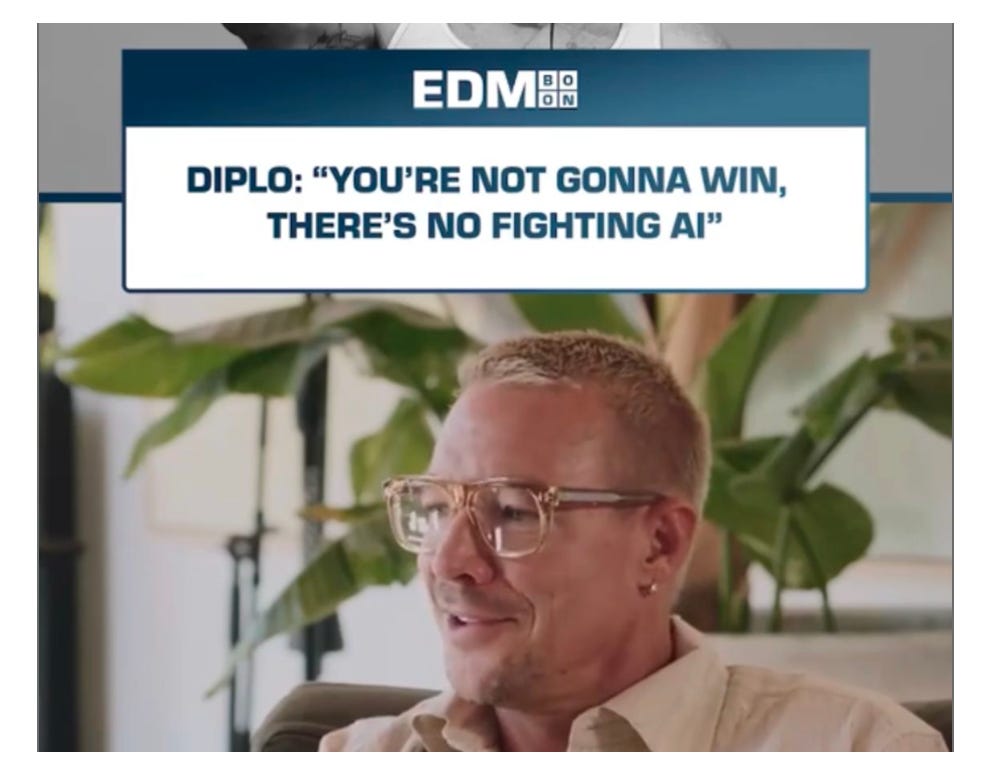
Diplo put it plainly: “You’re not gonna win, there’s no fighting AI.” I’m with him. But that doesn’t have to mean capitulation or some stoic shrug. It’s an invitation. Embrace music AI, and use it to create cooler shit.
Funny enough, Fenix said something similar: keep up with new tech or get left behind. He’s not wrong. He just forgot the other half. Keep up, but you still need to sound like yourself.
There’s no hard bifurcation here, pure human art on one side, soulless machine music on the other. There’s music, and people making it with new tools the way they always have.
AI and music belong together.
Sousa was wrong about the machine. He was right about the soul.
But, what of the next generation? What about people *learning* to make music with AI, and not with instruments? How will they even know if they sound “like themselves”?
It’s easy to decry AI slop, but I feel like this post misses the point that as AI gets better, there will be less and less “slop.” Eventually, we will be to the point where we can tell AI “write a love song that will appeal to the masses,” and it will write a number 1 radio hit. And the people listening to it won’t care, so do artists really want to cede their jobs to AI like that?
Because every piece of technology has- in some way- increased the with ease which something is done. And that either makes something more widely accessible, or makes some workers redundant, or both. I’m not saying AI can’t be used for good aims, I’m saying it’s potential for harm likely outweighs the good. And people caving and going along with it because everyone else is doing it isn’t answering that question at all.
Tom, thanks for a thought-provoking post. Your historical examples make a strong case for AI’s place in music. Betting against it probably would likely make me the guy in 1906 shorting the phonograph.
But what happens when polished songs and manufactured artists become limitless yet our attention doesn’t?
Verified human authorship could become more valuable. Helping a musician create is different from generating the song, singer, and backstory. I can enjoy a breakup song and still wonder whether anyone actually got dumped.
Vinyl’s renewed appeal offers a useful parallel. Convenience didn’t erase our appetite for a tangible connection to music. AI’s abundance could deepen our desire for a human one.
That means credible verification: who wrote it, who performed it, and where AI contributed. “Human-made” should be something listeners can trust, not just a sticker on the album cover.
The transition could be rough. Musicians may face greater competition for streams and pressure on publishing income. But those who sustain their craft and audience connection may eventually command a premium.
I’ve been digging deep on a business idea around this with a longtime music-industry friend. Once we have it dialed, I’d love to run our rough mix past your ears.
When AI can make endless music, will knowing a human made it become the thing worth paying for?